
QARN meetings: next planned meeting dates – by Zoom:
Saturdays on Zoom – 9th January 2027, 10thApril 2027,
with our in-person and on-zoom AGM on 10th July 2027
and then Zoom on 9th October 2027.
Continue reading “QARN next meetings”

Unmasking and Unmaking the Hostile Environment – let us see what Love can do
QARN meetings: next planned meeting dates – by Zoom:
Saturdays on Zoom – 9th January 2027, 10thApril 2027,
with our in-person and on-zoom AGM on 10th July 2027
and then Zoom on 9th October 2027.
Continue reading “QARN next meetings”6 April 2025 – updated QARN leaflets:
Be amongst the first to see footage from Nowhere To Go, a documentary on Europe’s broken asylum system and those caught up in it. Every ticket and donation goes directly towards finishing the film.

With thanks to the Quaker Asylum and Refugee Network for supporting this event and making it possible.
Saturday 28 November 2026 at Westminster Quakers, 8 Hop Gardens, London WC2N 4EH, 6pm Doors open.
Please use the side entrance at No 8 Hop Gardens. Turn left at the Côte Brasserie on St Martin’s
Author: Catherine Henderson, Hertford Meeting
We need to talk about Fascism. Not the Fascism we learnt about at school, but the 21st-century version. Most apparent in the US but also spreading ominously across Europe, Fascism thrives on human insecurity and polarisation. It pushes its way up through the cracks in society. We don’t always notice it at first; we don’t want to notice it.
Some members of the Quaker Asylum and Refugee Network (QARN) Steering Group have begun exploring Fascism as a result of a question arising from a talk by Joanna Frew, outreach co-ordinator for Rethinking Security, who spoke at our AGM back in July. She suggested we explore why it is that people protesting peacefully in support of Palestinians, or demanding our leaders address the climate crisis, are far more likely to be arrested than anti-migrant protesters. This connects with our particular concern about the worsening attitudes towards, and treatment of, people coming here to seek safety and a better life.
Read more here
Home Secretary Shabana Mahmood has provided final details of the Government’s ‘earned settlement’ policy in a statement to the House of Commons this afternoon.
As expected, the standard qualifying period for indefinite leave to remain (ILR) will be increased from five to 10 years for most migrants, under a new system in which the time required to qualify for settlement will depend on applicants’ earnings, employment, integration and wider contribution to the UK. The Home Secretary said the reforms will be implemented “over the course of 2027”.
Under the new rules, a five-year route will remain available to people earning more than £50,000 a year, as well as those working in certain public service professions, including doctors, nurses and teachers. The highest earners, with salaries exceeding £125,000, and those arriving through the UK’s highest talent schemes will be able to apply after just three years. Everyone else, including those earning less than £50,000, will face a standard 10-year qualifying period.
Read more:
The Quaker Asylum and Refugee Network (QARN) has urged the Planning Inspectorate to reject Home Office plans to reopen Haslar Immigration Removal Centre (IRC) in Gosport and expand Campsfield House IRC in Oxfordshire.
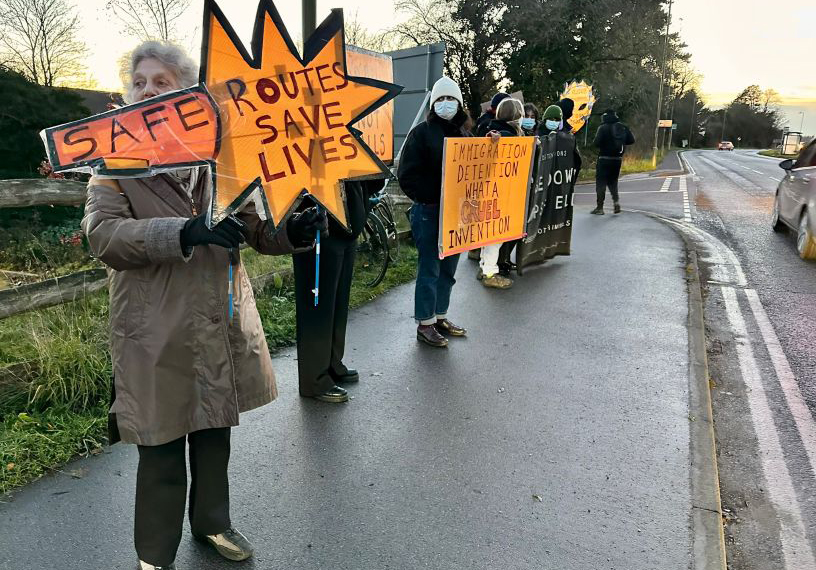
In its responses to the Planning Inspectorate consultations, QARN argued that the applications should be refused and called for a public inquiry if approval is granted.
Continue reading “Quakers oppose immigration removal centre expansion”More than 200 charities have signed an open letter (1) to the incoming Prime Minister Andy Burnham today urging him to reject the politics of division and forge a new path for asylum seekers and refugees in the UK.
The letter, coordinated by campaign coalition Together With Refugees, has been signed by 219 organisations from local volunteer led groups to leaders of national charities including Care4Calais, Choose Love, City of Sanctuary UK, Freedom from Torture, NACCOM, Refugee Action, Refugee Council, Scottish Refugee Council and Women for Refugee Women.
The letter states: “As leaders of charities and organisations supporting refugees across the UK, we witness every day the extraordinary compassion shown by ordinary people. While recent scenes of far-right marches, intimidation and attempts to spread fear have dominated headlines, they do not reflect the reality we see in communities across the country.”
Continue reading “TWR Press release: More than 200 charities urge the new PM to ‘reject the politics of division’”
Happy Baby Community is a project started by local Quakers and we discussed this issue at the recent QARN AGM. Another extreme example of what the hostile environment looks like in practice …
What is the Issue to be raised in parliament?
Healthy Start Vouchers are given to all pregnant mothers and children 4 years and under in England, Wales and Northern Ireland except asylum seekers.
This makes no sense whatsoever in Public Health terms as most of these children will grow into adulthood here and will potentially have poorer health outcomes than the rest of the population.
The government had a chance to change this in the Child Poverty Strategy 5th December 2025, but they failed to include asylum seeking pregnant women and children under 4 years.
Asylum seekers in hotels receive £9.95 per week per person. The hotel food is of poor nutritional value and many of the women we work with have gestational diabetes and their children lack a balanced diet.
Continue reading “Healthy Start Briefing”Proposed changes to the immigration and asylum systems pose significant risk to individuals in them, and the country as a whole. These hostile policies create a system where all migrants face increased discrimination, division and hate. Labour must take the opportunity of a change in leadership to rethink this course of action.
Increasing lengths of some visa routes from five years to ten, at least, and then applying it retroactively for those already in the system is a cruel and inhumane proposal which leaves many migrants in fear for our futures. Unable to build lives, or have stability, these proposals undermine our health and our families.
Continue reading “Changes to the immigration and asylum systems risk increasing harm”
Where a person is in the UK without valid leave to enter or remain, the Home Office needs to make and maintain contact with them in order to progress any outstanding application, to encourage the person to regularise their stay or depart the UK voluntarily, or in some cases to work towards an enforced removal.
This inspection – which was conducted between September 2024 and February 2025 – examined how the Home Office seeks to maintain contact, what it does to re-establish contact if it has been lost, and the impact of lost contact on both the business of the Home Office and on the migrants themselves. As ever, inspectors focused on the efficiency, effectiveness, and consistency of the Home Office’s efforts.
The sheer scale of the task presents the Home Office with a challenge, and this inspection found that cross-system working to address this challenge is inhibited by a plethora of hand-offs, poor communication, and weaknesses in data collection and sharing (compounded by deficient IT). Some steps had been taken towards promoting a better system-wide approach, but the extent and interdependent nature of what needs to be done means there is a risk that the resources required to deliver further improvements will not be found or, if found, will be diverted to other priorities before the necessary changes can be made and embedded.
Continue reading “An inspection of Home Office management of contact with migrants who are without leave to enter or remain”When the present system of administrative reviews (AR) was introduced in 2015, replacing a raft of rights to appeal to the Immigration and Asylum Tribunal, the government’s stated intention was to provide “a proportionate and less costly mechanism for resolving caseworking errors.” At that time, the government committed to a service standard of 28 days for the Home Office to complete an AR, which it explained was much faster than the then average of 12 weeks for an appeal to be heard. When this inspection of ARs began in 2025, the system was a long way from operating as intended.
This inspection focused on the resourcing of the two Home Office teams responsible for handling AR applications; workflow and the prioritisation of AR applications; the quality, timeliness, and consistency of AR decision making, including quality assurance; and communication and engagement between Home Office AR teams and applicants and stakeholders.
Continue reading “Inspection report published: An inspection of administrative reviews”